Labels

Tuesday, April 26, 2011

Fly Fishing The Davidson (No, Seriously, I Really Did)

One would have thought a serious outdoorsman like myself (he writes with tongue planted firmly in cheek) would have been chomping at the bit to take advantage of the fishing opportunities in my new surroundings. When I moved to these Blue Ridge Mountains a little over a year ago, I left the piscatorial bounty of the marshes, sounds and blackwater rivers, not to mention the nearby surf and Gulf Stream waters, of the Coastal Plain for the clear, cold trout streams of western NC.

Truth be told, I was a little intimidated by the prospect of jumping headlong into the fly fishing scene here. I am little more than a dabbler in the beautiful art of roll casts and nymphing, more comfortable with a spinning rod or a tuna stick really. The thought of laying out the cash for a new fly rod, line, leaders, tippets and tackle was daunting, not to mention I know very little etiquette when it comes to the gentleman's sport.

When my friend Sean called to invite me on a guided fishing expedition to the famed Davidson River, I jumped. Here was my chance to fish under the tutelage of a local expert and use gear suited to the task. The trip was a birthday gift to Sean from his wife and allowed me to join in for a nominal fee.

After a 45-minute drive from Black Mountain, Sean and I met our guide. Starr Nolan. Starr guides for Brookside Guides of Asheville and immediately set to work preparing us for the numerous, but heavily pressured fish near the state hatchery stretch in Pisgah National Forest just outside Brevard.
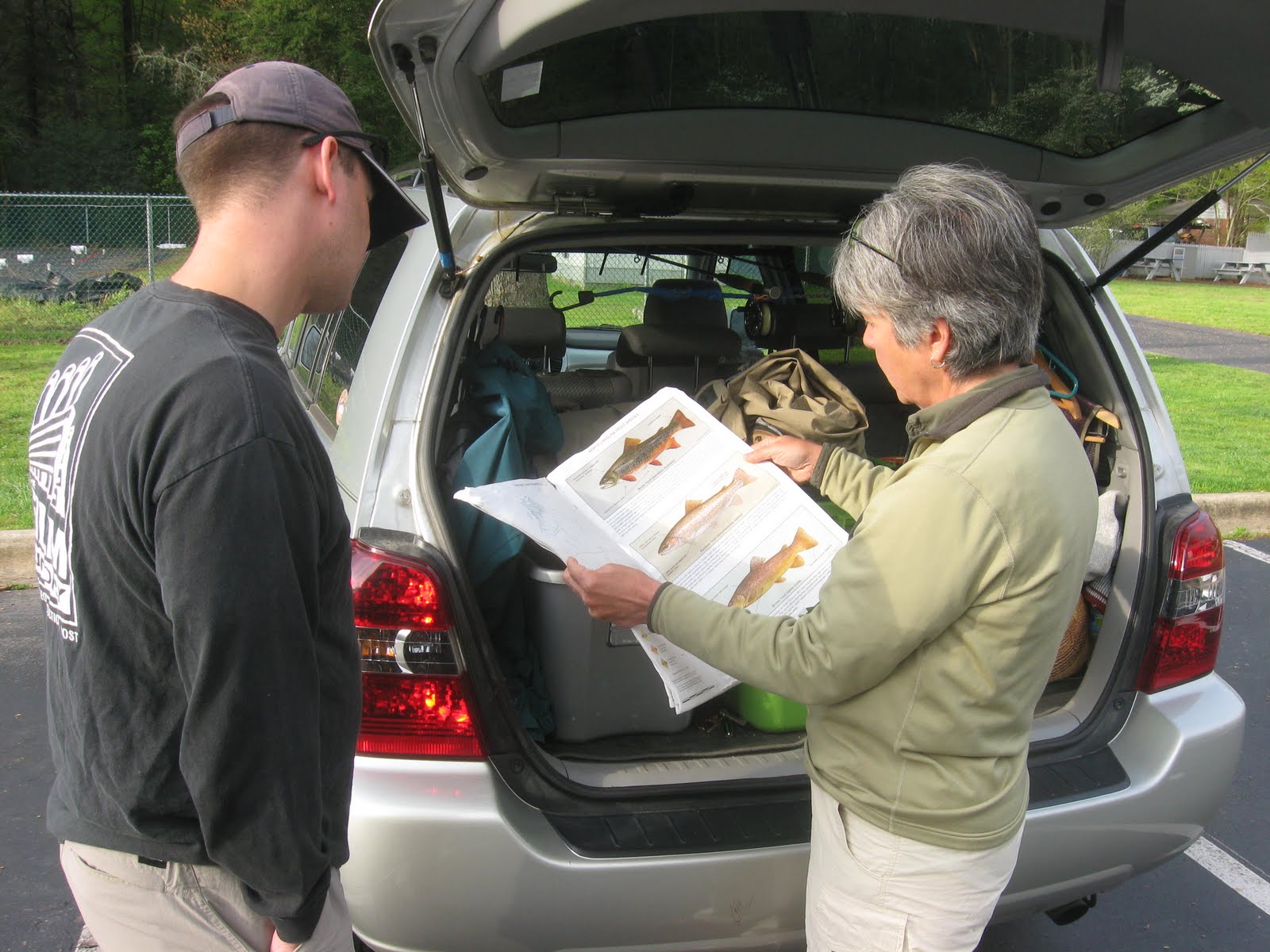
What 'er we fishin' for Starr?
After a quick casting lesson, with special emphasis on the roll casts suited for the Davidson's tight quarters, we headed to the river to find an open pool to fish. Going in, Starr warned us the river would be crowded and the fish would be wary, but there are enough trout to make it worthwhile for everyone, including novices like Sean and me.

She wasn't kidding. The popularity of the hatchery stretch, on a beautiful Saturday morning in April no less, is a little intimidating. In some pools it looked like shoulder-to-shoulder angling. Add that to the fact we were going to be nymph fishing and I was pretty skeptical of our prospects for success. It didn't help much that a gigantic brown trout was holding in the current at the exact spot we stepped in. When I pointed to the 20-inch-plus monster excitedly, Starr simply acknowledged its presence with a shrug and went in anyway. "Oh boy," I thought, "This is going to be brutal."

With a little more experience with a buggy whip than Sean, I was instructed to head up to the next run and start fishing on my own while the other two stayed back to fish together. Starr tied a large, garish looking nymph with a red bead in the middle of a length of greenish swizzle stick and said, "Try this first. You never know what this fish will do when they see something completely different." I looked at the crazy fly with a bit more trepidation, but hey, she was the guide and you always do what the guide tells you.

It took a little while to get used to the drift and finding the fly as it tumbled across the rocky bottom, but I got the hang of it and eventually saw a trout chase it a short distance as it drifted through the run. With a little more work and who knows how many unseen strikes, I saw and missed my first bite.

Dude, that was a biggun'!
Meanwhile, Sean and Starr continued to work out the kinks on their stretch of water and I watched Sean set the hook on a big fish. The fight didn't last long. Sean only just started fighting the brute on the reel when it broke off. "How big?" "18-inch rainbow," they said. Holy crap!

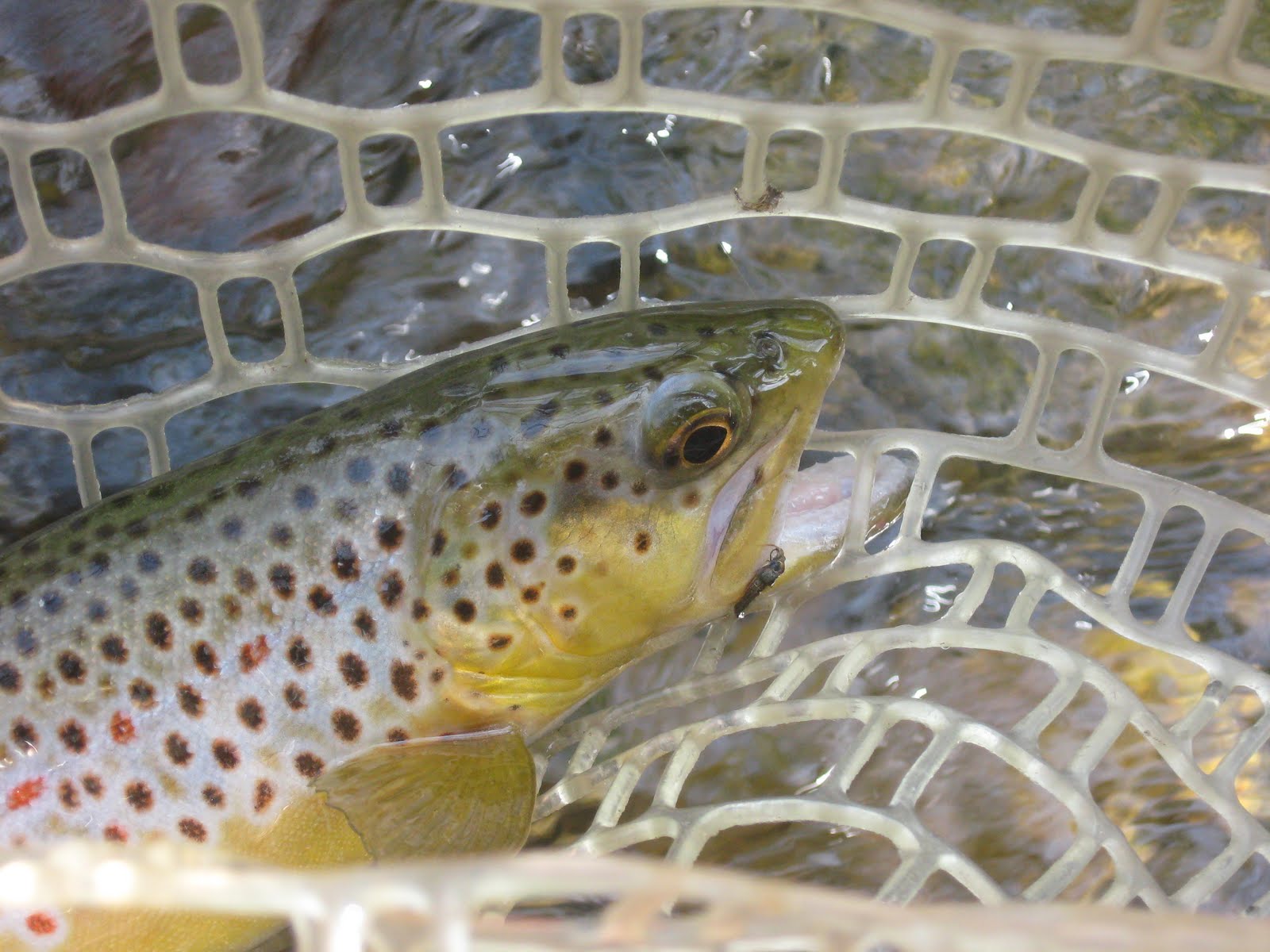
After several minutes without any action, Starr waded over to me and changed my rig to a tandem nymph and strike indicator. The bit of yarn that served as a bobber (don't tell Starr I called it that) put me back on a steep learning curve as I tried to figure out how to get the drift to match up with the flies tumbling along below. Then it happened. Just as I was about to pick up my cast, I felt a weigh against the line, fish on! I played the little brown against the current and eventually brought it to hand - a beautiful 9-incher hooked in the corner of the mouth. I announced my catch with a prideful "Ahem!" to Sean and Starr downstream and quickly released it, as the area we were fishing is catch-and-release only.

Buoyed by success and new confidence, I finally started fishing. My senses and body tuned in to the river and its immediate surroundings. There! Is that a caddis fly? Look! Another one. There's a small fish rising every few minutes on the other side of the pool. I bet that sluggish spot behind that boulder would be good.

I started to feel like I was hunting rather than fishing. This fly fishing thing was pretty alright.

The sluggish spot behind the boulder did hold a fish and I struck home when the indicator zigged when it should have zagged. The trout raced back out to the heavy current and I let it go downstream. I followed while Starr moved up into position with her landing net. After a short give and take, she netted the foot-long brown for me and offered sincere congratulations. It wasn't the biggest fish in the river by any stretch ofthe imagination, but I couldn't have been happier. I had come to the Davidson and caught a fish as it was meant to be caught. We snapped a few pictures and let it go.
A trophy to me.
At this point, you might be getting the impression I am a fly fishing idiot savant. I am not. Think more idiot, less savant. As the morning wore on, Sean and I kept Starr busy untangling our tippets, retrieving our flies from the rhododendrons and ringing her hands over shamelessly missed strikes. She worked her tail off,  but had her revenge.

With just a few minutes remaining in our session and me already given up and lounging on the bank, Starr asked Sean for his rod so that she might show him what a perfect drift looked like. She cast the rig expertly into a riffle Sean had been flogging for the last 10 minutes and, with a flick of the wrist, the rod bent over. "Oh, you're going to kill me," she said in horror as a 15-inch rainbow skyrocketed out of the water. There was some back-and-forth I couldn't hear, but eventually Sean took the rod from Starr as she unclipped her net and made toward the fish. The leader was touched, but the fish made a final surge for freedom and snapped the tippet. Ahhh well, the Davidson rarely gives up its treasures easily.

On the ride home, Sean and I talked fishing and mountain streams and the beauty of the Blue Ridge. As for fly fishing, I'm off the fence. I'm all in.

Friday, April 22, 2011

The Season Of The Grill

I know some of you are still languishing in the cold, wet throes of winter's last breath, but here in the Blue Ridge Mountains it's time to transition out of the kitchen and onto the patio. The era of braising, stewing and roasting is over. The dawn of the grilling season is upon us.

If you eat wild meats like Sue and I do, you already know how tricky it can be to get the most out of them when you're cooking outdoors over an open flame. The meat is so lean, it's quite unforgiving on the grill. One second you've cooked your venison steak to perfection, the next second it's gone too far and turned leathery on you. This isn't the kind of grilling where you can go inside for another beer and leave the flame unattended. You need to have your cooler next to the grill and be there with tongs at the ready. The good news is, wild game cooks very quickly over high heat, so you probably won't need another beer before it's finished.

I love shish kebabs. As a kid growing up near Boston, I remember the lamb shish kebabs they serve at Santarpio's Pizza of East Boston. They are simple; cubed lamb skewered without distracting and unnecessary vegetables, held over glowing hardwood embers by a sweaty old guy named Gino (I made that name up, but he is sweaty and old). The intense heat puts a smoky, char on the edges, but the meat stays pink and moist in the center. It's wonderfully "lamby" with a satisfying undertone of onion essence, despite the fact there is no onion to be found on the skewer. They are the mark when it comes to shish kebab.

That mysterious onion flavor has confounded and haunted me until I opened up Soheila Kimberley's "Taste of the Middle East," published in 1996. There, I learned about the Persian method of marinating meat overnight in a simple blend of grated onion and saffron water. Kimberley uses lamb or beef fillet for her "kabab bahrg" whose origin is Iranian. I, of course, substitute a high quality venison roast or loin. Otherwise, I stick to the script, which goes like this...

  • 1 pound venison roast, cut into strips about 1/2-inch thick and 1-1/2-inches long
  • 2-3 saffron strands
  • 1 large onion, grated
  • 1 Tbsp butter, melted
  • 3 Tbsp sumac to garnish
  • cooked rice (or couscous) to serve
Take the meat out of the freezer a day ahead of time and thaw it in the fridge. Grate the onion (I used a box grater the first time, then I wised up and used the attachment on my Cuisinart). Pour a tablespoon of boiling water over the saffron strands and allow them to steep for a few minutes before adding them (with the infused water) to the bowl of grated onion. Add the venison to the bowl and mix it to coat. Cover it loosely with plastic wrap and marinate overnight in the fridge.

Holy onion juice! That's ruined, right?
When you're ready to grill, take out the venison and calm yourself. All that onion juice now drowning your beautiful venison roast has not ruined it - trust me. Thread the meat tightly onto your skewers. I know many kebab recipes call for making sure you leave space between the chunks of meat for even cooking, but this venison needs to be packed closely so it won't dry out on the grill. Now is the time to prepare separate, vegetable skewers if you're including them. Kimberley suggests tomato wedges here, but I have yet to make this during tomato season, so I haven't included them... yet.

Melt your butter and bring it out with a basting brush to paint the kebabs as they cook. Season the venison skewers with salt and pepper. I cook the kebabs over a high flame with the lid down for five or six minutes, then flip them over and finish the grilling for another five or six minutes. I know this sounds like a long time for such thinly sliced venison, but that's why you packed them so tightly on the skewer and baste them with the butter periodically until it's gone. The outside of the meat gets a perfect crust while the inside is pink and juicy.
A mediocre picture of a superb dish.
Now, sumac is an obscure spice, but if you happen to have it, use it here to finish the dish. It has a lemony/sweet paprika quality and it's traditional for this preparation. You could substitute some squeezed lemon juice and a sprinkle of paprika with great results as well.

What you end up with is a shish kebab even Gino would be proud of.

Tuesday, April 12, 2011

How Not To Hunt A Wild Turkey

Turkey sex toy.
Well, you want the long version or the short one? Wait a minute, this is my blog. You'll get both.

The North Carolina wild turkey season is just three days old and already I feel as if I've been taken to the wood shed. If I could draw a comparison to a current sports storyline; my season so far resembles the Boston Red Sox - full of promise, short on success.

In the days leading up to Saturday's season opener, I drove through the pre-dawn darkness three times to my happy hunting grounds. I located at least 11 different gobblers sounding off on or near the property and devised a game plan to put me in the meat.

On turkey opener eve, my beautiful wife, Sue, a.k.a. "The Turkey Ninja," announced she wished to join me as an observer in the morning. This was welcome news. In my efforts to introduce her to the world of hunting, Sue has proven reluctant. Turkeys seem to be the exception though, at least once a season anyway.

On the drive out, I hit a rabbit. It was not an auspicious start, as Sue is loathe to harm any creatures trying to cross her path. It may seem like a strange reaction for a woman on her way to presumably watch a wild turkey get shot in the head, but it's really not. The hunters I know consider all lives to be precious. Any animal killed accidentally or through negligence is to be mourned as a wasted life - very different from a life taken intentionally for our sustenance. We continued on the drive in silence for awhile, then I broke it to ask if Sue was still on my team. Her response was noncommittal. I needed to rally.

We settled in at a spot very close to where I'd heard a gobbler on the roost the week before. As we awaited the sunrise and the gobbling to commence, the surrounding hills came alive with birdsong. The second week in April is prime time to meet the northbound migration as it passes through western North Carolina. From our ambush, we could hear whip-poor-wills, a wood thrush, northern parulas, prairie warbler, black-throated green warbler, yellow-throated warbler, a broad-winged hawk and finally, a wild turkey. But it was not the turkey we had planned to target. He was down slope and distant. I knew we were in the right spot and fought off the urge to chase the gobbler.

By 7:15, it started to become obvious the turkey I expected to be roosted in front of us wasn't there. The old tom down the hill, however, was still gobbling up a storm so I finally broke out my trusty box call and gave a loud sequence of clucks and yelps. He responded with a resounding gobble and, after some 20 minutes of convincing, started heading our way.

From his incessant cackling, it was easy to follow the tom's progress as he trekked up the hollow and then turned left into a narrow gully that led to Sue and I. He went quiet for five minutes or so, then the ground shook when he fired off again; very close, but still unseen. He was pacing around just below us and needed to come a few more yards for me to have a shot. I whispered to Sue to cover her ears, as I anticipated a shot to my left and across her body. The turkey gobbled again and again. I could hear his footsteps right below us but there was no way I would risk trying to belly up to the lip of the gully. Turkey hunting is all about patience and I was pretty sure at that point we had game and set and were just waiting on match.

What do you mean, 'That's it?' I thought you said we were gonna get him.
It never happened. The bird kept right on gobbling; answering every yelp and cluck I made with my box call, but it became quite apparent he was moving away from us, back down the gully and out into the larger hollow. We tried moving in behind him to see if we couldn't rekindle that spark we had before, but the turkey kept on moving out in front of us and finally went up and over the ridge at around 9 a.m., never to be heard again.

I had Sunday to reflect (there is no hunting on Sundays in NC - gasp!) and then went back after them yesterday morning. I was on my own and started in a new spot that had three toms gobbling from their roosts back during my scouting days.

It didn't take long for the birds to fire up and I made my approach up the hill and across several ridges until I felt I was in a prime spot. When it sounded like the birds were gobbling from the ground, I called to them and they answered enthusiastically. After an hour of talking back-and-forth with the gobblers, it became apparent that two of them were starting to close the distance. Within minutes, I was back in the same position I'd been with Sue the day before - gun at my shoulder, pointed downhill, just waiting for one of those old longbeards to step into view. Instead, the birds stayed on the other side of the slope and kept on walking to me. Now they were parallel and on my right. I shifted to point the gun barrel that way and thought about how great it was going to be to drive home with a turkey that morning. But the birds kept on going and soon they were above and behind me - gobbling to beat the band. The hairs on the back of my neck were at full attention.

I had to decide on an all-or-nothing maneuver. The gobblers were behind me, in range, but there was nothing I could do about it unless I turned to face uphill. I could also have just stayed frozen in place and hoped for one of them to come back down, but I went for all the marbles and shifted to my butt in a fluid motion that pointed me in the right direction. I was too late. The birds had already crested the rise and they must have watched my little pirouette with smug amusement. In the half-second it took to situate myself, alarm clucks and footsteps running away were the last I heard of those turkeys. I'd been busted.

I was dejected. It was the closest I'd come to killing a wild turkey in three years and I'd blown it because I hadn't shifted my ass in time to keep up with the birds. It was only a little after 8 a.m., however, and a gobble off in the distance indicated the game was still on.

To keep an long story only slightly less long, I won't bother to detail the four other times I had gobblers responding to my calls. They all stayed off in the distance and nothing came of it. I will, however, tell you of my final, heart-breaking encounter of the day.

I was exhausted, having climbed to the top of the mountain and back, and the sun was high enough to have the sweat pouring down my face. I was hungry too. All I'd had to eat since I woke up was a mug of coffee and a lousy pear. On my way back to the truck, I came up short. A hen turkey was standing in the middle of the trail. I threw the gun up, just in case it turned out to be a jake (a 1-year-old male turkey - legal fodder) and watched her as she fled up the slope. It was 11 o'clock. I thought to myself, "I wonder if she just left a gobbler." I hit the call and a thunderous gobble erupted to my left. It sounded like he was just across the creek, so I slipped into the woods, forded the creek and put my back up against a pile of rocks. I yelped again and he answered. He was very close. I put the box call down and got ready. I waited and waited and waited. I should have waited some more.

I grew impatient after 10 minutes and slid my hand towards the call to try to give him some soft yelps and get him to gobble again. As my hand inched away from my body, I saw the feathered velociraptor slipping through the rhododendrons, just 20 yards away. Our eyes met at the same instant. He had me pegged the instant I moved my fool hand. For several long seconds we were frozen like that, then he turned to run away and I brought the gun up to my cheek and pointed it at his retreating head. It wasn't an ethical shot and I checked myself from taking it. Instead, I watched the big tom cross the trail I'd just come off and head up the slope to safety. I was busted again.

I nearly cried. I know damn well not to make a stupid move like that when a gobbler is close at hand. I don't know why I did it. Maybe I just wanted to hear him gobble again. Maybe I'm just an idiot. Maybe I'll never kill another turkey for as long as I live. I had to take today off from hunting to let my mind settle and body recuperate. Tomorrow I'm going back in. Some people are gluttons for punishment.
This was waiting for me back at the truck after Day 2.

Editor's note: If you want to see some real turkey hunting, check out this video link sent in by Bumbling Bushman pro staffers, Brian and Nate. With Nate on the camera, Brian shot his first archery gobbler on opening day in eastern North Carolina. Obviously, a turkey dies in the video, so consider yourselves forwarned. Enjoy!

Thursday, April 7, 2011

Day Dreaming: The Next Big Adventure Destination

It's been a long year. Heck, it's been a long 18 months. Eighteen months ago, Sue packed up her things, took the dogs and moved from our home near the North Carolina coast to live with my parents so she could start a new job in Asheville. I stayed back to try to sell the house and keep my day job while looking for work opportunities in the western part of the state.

Those six months before the house sold weren't terribly fun. I was lonely. The housing market sucked. The job market sucked even more. Meanwhile, Sue was living out of her suitcases in a guest bedroom with her in-laws (who are awesome by the way) trying not to lose sight of the life we had envisioned for ourselves.

Finally, we got a legitimate offer on the house, two weeks after I had resigned from my job, pulled up stakes and moved in with Sue and my parents. I just couldn't take it anymore. Sue and I needed to be together for this next leap of faith.

It didn't get much better for awhile. I took a job teaching prep school marine biology outside Atlanta for two months. When I came "home" on weekends, we spent the daylight hours searching for a house to call our own. We had a contract on one that we loved and it fell through - more despair. We found another that we love and now we live here in Black Mountain, N.C.

But this tumultuous period isn't over yet. I'm still looking for permanent work and Sue is still getting comfortable in her career while coordinating a move that will bring her parents closer to us. There hasn't been a lot of "us" time and that's got us longing for a much-needed vacation when things settle down.

As a member of the Outdoor Blogger Network I get weekly writing prompts with topic suggestions that might help me and my fellow bloggers come up with some fresh content for our readers. Earlier this week, the proposed topic was to write a post about my dream outdoors destination. Perfect. It happens to be something I've been thinking about quite a bit these days, for those reasons I just explained. So here goes ...

The Bumbling Bushman's Dream Destination; Domestic

The Sandhills region of Nebraska. (Photo by Cory Ritterbusch)

When I was a transient field biologist during those half-dozen years after college, I spent a field season working with a guy named Stephen; a proud and native Nebraskan who practically insisted that I and some of our coworkers go with him on those odd weekends when he returned to his home in the Sandhills.

To say I had never given Nebraska much thought before that spring and summer would be an understatement. Nebraska? Why the hell would anyone want to go there? To be honest, the only reason I went along for the ride from our field station in central Missouri to Stephen's parents' place was for the promise of some home cooking. I was not prepared - no matter how glowingly Stephen had spoken of it - for the absolute raw beauty of Nebraska.

It helped that Stephen was a consummate guide, who knew his audience and showed us prairie pot holes on the sides of the road, where teal, shovelers, pintails, wigeon and even Wilson's phalaropes bobbed and weaved through their courtship displays. He showed us sharp-tailed grouse, pheasants and wild turkeys. There were pronghorn antelope and mule deer. When he took us to a Nature Conservancy property on the banks of the Niobrara River, we watched in awe as a herd of free-ranging bison encircled the truck.

The Niobrara River - a mile wide and an inch deep (Photo by Larry Mayer).
From our campsite one evening, we watched a line of storms roll across the grasslands. While most of us were thinking about battening down the hatches and preparing for the deluge, Stephen jumped up and ordered us into the truck. He drove like a madman; up out of the river valley to the top of the escarpment, where we watched the lightning flash across the sky. It was magical (and I don't throw that word around lightly).

From the river, we met the bulk of the sandhill crane migration as it passed on its way north. Tens of thousands of cranes, joined by tens of thousands of ducks and geese - it was more biomass than our minds could process. There was winged life virtually everywhere you looked.

I was a fisherman then, an avid birder and a lover of the outdoors, but I was no hunter. Now, as I consider Nebraska through my relatively new predator's eyes, I have to wipe away the tears of lost opportunity. Yes folks, if I could choose one destination to stretch my legs as a hunter, it is Nebraska. Stalking whitetails, mule deer and pronghorn antelope; trekking across a sea of grass for sharp-tailed grouse and ring-necked pheasants; jumping out of marsh blinds to draw a bead upon ducks and geese of every description, calling in the Merriams race of the wild turkey (the most beautiful one to my eyes) - it sounds even more like heaven to me.

I know there are other western states that offer all of those game animals and more, but I am no mountain man. Having lived and worked in several Rocky Mountain states in earlier days, I came to the reluctant conclusion that I am not the right person to soak in all of the beauty and majesty that comes with them. Those Rockies are awesome, too awesome for my Yankee eyes. I found that, after awhile, I became desensitized to the scenery surrounding me. It's everywhere. You can't get away from it. I found no comfort in them. But I did in those endless hills of Nebraska and I hope to again someday.

The Bumbling Bushman Dream Destination; Abroad

Orcas in the Sea of Cortez (Photo by ???)
Perhaps it was that one time I read Steinbeck's book, or the revisitation by Discover Magazine decades later. Maybe it's the occasional Nat Geo article and photo spread or the once-in-awhile nature programs that highlight it. All I know is, for a long time now, I have wanted to travel to Baja California and the Sea of Cortez.

Please don't correct me if I'm wrong. Maybe the crystalline waters aren't teeming with whales and dolphins, tunas and marlin, sea lions and manta rays like they do in my head. Maybe the magazine articles about catching Pacific sailfish from kayaks are stretching the truth. Perhaps the land is not so wild or wonderful, where the desert meets the sea, as I'm wanting to believe. It could be commercialized, "discovered," ruined. I hope not. Someday I will see it for myself and I'll let you know.
Photo by johnng650 (whoever you are)

Tuesday, April 5, 2011

Reaping What I Sow

When we moved last summer, it was too late to start a proper vegetable garden. Instead, Sue and I focused on a few potted herbs for the kitchen and establishing a landscape of native vegetation on our small, high country lot in the town of Black Mountain. Most of my time in the yard involved pulling up, weeding, herbiciding and otherwise eradicating the host of non-native invasive plants that were (and in some spots, still are) choking out the natural plant diversity. I still have a long ways to go. There's vinca or "periwinkle" that needs killing, oriental bittersweet that needs poisoning, multiflora rose that needs yanking, Japanese honeysuckle that needs stomping and a firebush that is trying to mount a comeback after I spent one back-breaking afternoon last August digging, chopping, hacking and hauling the mother-bush away.

That said, it has been decided that we will, once again, attempt a vegetable garden this year. I admit I was somewhat reluctant to put too much effort into the endeavor. Sue and I have grown, or more accurately, tried to grow, our own vegetables since before we were married - never achieving the level of success I would equate to justification for our labors and expenses. It would seem to me that we have never planted a garden in optimal conditions, be they soil, sun or water, nor have we ever been able to maintain the level of enthusiasm required to bring a garden through the rigors of weed season and summer swelter.

Why grow my own when my neighbors will sell it to me?
Now that we live in a land where independent, local farmers grow a bounty of organic and conventionally raised crops available to us from May through October, I must say my desire to half-ass another kitchen garden is on the wane.

Irregardless of my trepidation entering this project, we set about building our first raised bed gardens about a month ago. I hit up the local big box home improvement center for 48-some board feet of 2x12 untreated lumber, along with various and sundry hardware to make it all stick together. Since I am largely incompetent when it comes to construction of any type, I called my father out to the house for some expert assistance.

Dad is something of an idiot savant when it comes to such things. Measurements and workarounds that would take me hours of pondering and unacceptable losses from the stock pile to the kindling pile, come to him in a free-wheeling, do-it-in-your-head sort of way that has always been magical to me. In other words; I had the right man for the job.
"Picasso" at work.
In no time, Dad and I had two 4X8 boxes assembled and ready for deployment. Sue took the lead of this next phase of the project, weighing the pros and cons of sunlight versus culling tulip poplar saplings and pokeweed.
I dunno Sue. We might have to pull up that dandelion.
"The Decider" puts her back to it.
In a fit of inspiration, Sue and I set to "double digging" the base layer of our raised beds before adding our soil. This involved turning over the hard, red clay that now constitutes our planting medium in the backyard, thanks to the nice contractor who hauled off all of our topsoil when he cleared the building site. Whether or not it was worth the extra effort, I supposed we'll find out later. A couple of trips to the mulch yard had us flush with a yard of "Amy's Garden Blend" (whatever that is) and someone else's topsoil (thank you, you poor, unsuspecting saps).

Somewhere along the line, I found my second wind for this gardening thing. I think it had a lot to do with admiring everyone else's hard work. In the past three weeks, I've tried to do my part by sowing radishes, arugula, lettuce, carrots and sugar snap peas into the rich, fertile soil. Sue went and bought and old trellis for the peas to climb and I've been keeping a journal of our effort and expenses.
How does my garden grow? Quite nicely so far, thank you.
That's not to say we haven't encountered some setbacks already. I am learning on a routine basis that I was perhaps a bit over-ambitious in my planting schedule. The calendar says spring, but we still have nights in Appalachia that dip below freezing and endanger my little seedlings with death by frost. (Heck, it was snowing here as I started typing this post.) I have a large tarp folded at the ready for overnight protection when needed. Our tiny vegetables aren't big enough yet to attract the attention of the neighborhood rabbits, but I recently discovered the "outside" cats consider Amy's Garden Blend the medium of choice for taking a crap. The prospect of free range cat scat has tempted Sadie and Piper to enter the garden, in spite of the repercussions. We have experienced some radish and arugula casualties as a result of these ill-advised intrusions.

Nevertheless, I look out on our growing crops every day and take pride in their early vigor. There's supposed to be a frost again tonight and I'll dutifully cover them up to keep them safe. For whatever reasons, I feel more engaged in the process this time around. Maybe, just maybe, this year will be different. Then again, I've been fooled before.
Full of promise.

Thursday, March 31, 2011

Hunting Marsh Hawgs (Part 2): Spotting and Stalking

Dawn breaking over the Low Country marsh is every bit as beautiful as the sunset and we were more than happy to putter around the lodge at Squirrel Creek Island Hunt Club and enjoy the view before heading out on our second day of hunting.

The Brothers Degan, ready for a new adventure.
Mark had taken his hog the afternoon prior, so Brian and his bow were up next and that meant spotting and stalking.

As we loaded our gear into the boat, David laid out his plan for the day. Our first stop would be to check out a dry hammock on the Intracoastal Waterway where he had a corn feeder set. We would ease up to the bait site and then slowly work our way across the island to see if we couldn't rustle up some action.

After a short boat ride, we disembarked and made our way up to the feeder. The only signs of activity there seemed to be squirrel related, so we continued on our slow push through the thick oak and holly upland. We must have been close to a bald eagle nest, as an adult flushed from a giant cypress snag when we crept underneath. Instead of flying off to a more peaceful perch, the eagle flew low circles over our heads, calling agitatedly all the while as if to purposely ruin our chances of sneaking up on a wild pig.

Whether it was the eagle's fault or not, we didn't come across anything during our stalk and David made the decision to initiate Phase 2 of his master plan. Back in the boat, we headed over to the spot Mark had killed his pig the day before. Along the way, we stopped at a couple of lookout posts and scanned for pigs foraging out in the marsh, but to no avail. With the tide nearing its lowest ebb, we needed to get to the "Tall Stand" quickly or risk being stranded in the canal. Too late. Well short of our goal, we bottomed out. A quick conference was convened and it was decided Mark would trek across the marsh on foot to take up his position in the stand while Brian, David and I would attempt to push the boat through the high spots and eventually make our way to the base of his tree.

Chest waders were donned and we started the grueling slog through the muck and mire - pushing, pulling, hacking and kicking the boat forward, inch by inch, foot by foot, yard by yard.
Keep pushing boys. I'll stay up here and take pictures.
I'm not gonna lie to you. There were times I thought we were done for, but persistence, blood, sweat and tears pulled us through and we finally made it across to deeper water. A couple of times we heard pigs moving through the thick sawgrass on either side of the ditch, but from our low vantage it was impossible to see more than a few feet into the marsh. When we reached Mark, perched comfortably in his lofty chair, the report was disappointing. He hadn't seen anything. A new wind direction made lolly-gagging around the site of yesterday's success a waste of time. We needed to keep moving.

Pigs eat em. Why can't we?
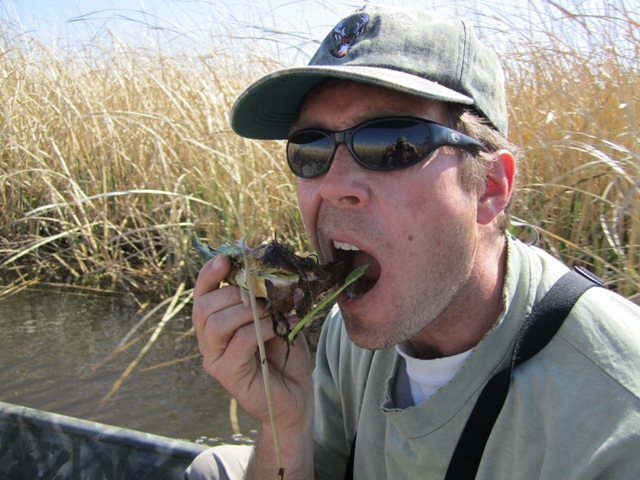
As often happens in times like these, our group of hunters started to lose focus. I can only imagine David's ire as he watched the Brothers Degan and I slip into a period of frat boy buffoonery. Marsh roots were pulled for examination and tested for culinary qualities. A stick fight broke out in the bow of the boat and at some point, a fiddler crab was dropped down Brian's chest waders with satisfying results.

Things settled down a bit as we approached the next lookout post and a steady breeze across the marsh masked our clumsy hike to the base of the stand. David climbed the rungs to scan for hogs, but came back down after a few minutes with nothing to show for it. He insisted we were in a good spot, however, and recommended we post a lookout back up in the tree and sit tight until something showed itself. I elected myself for the job of hog spotter and climbed up to the top of the ladder. I had just settled in when a dark shape out in the marsh caught my attention. It was a decent-sized pig, 400 yards away. Before I could put my binoculars down, a second, smaller pig joined it and Brian's opportunity had finally appeared. While the rest of the guys prepared to head into the marsh, I stayed put to watch the pigs and direct the hunters' approach. The wind was perfect. The only things standing in the way of Brian's success were the poor eyesight of the wild pig and its compromised hearing ability thanks to the rustling sawgrass. Oh, and of course Death Options A and B; sink holes and man-eating alligators.
The stalk begins.
Slowly but surely, the trio made their way across the marsh to the two pigs, which continued to root around content and unaware. From its pig-level vantage, the party looked back to me a couple of times for redirection. After 20 minutes or so the culmination of their effort seemed imminent.

A tall field of sawgrass stood between Brian and David and the pigs as they made their final approach. From my perch nearly four football fields away, I could still see the smaller, reddish hog, but I'd lost sight of its larger companion. It seemed to me the boys were about to stumble right into the red pig and my mind was screaming a warning, "Look right! Look right! Oh for the love of God, look to your right!" But on they trudged and the pig kept feeding, unaware. Suddenly, I saw Brian draw his bowstring back to his cheek, but he wasn't aiming at the pig I could see. A flicker of motion signaled the release of the arrow and the bigger hog suddenly appeared in an opening to the left of Brian and Dave. I watched it stop, stand for a moment and stagger a bit before it trotted out of sight into heavy cover. As it disappeared into the grass, I could see the fletching of Brian's arrow sticking out of its flank. We had a hit.

The boys regrouped at the spot where Brian had shot his arrow and I thought I could see a fist-bump exchanged between the two brothers and a wide grin creeping across Brian's face. They waited a good 15 minutes and then started moving along the path the stricken hog had taken. I wanted to get down and join in the search, but I reasoned it would be better to stay put and provide bullet back-up if the pig reappeared. As the trackers entered the thick grass, I scanned the openings out ahead of them.

It wasn't long after that, I heard something heavy sloshing through the mud and heading in my direction. It came from the same general area from where I'd last seen Brain's pig and I shouldered my rifle and peered into the grass below. The back of a hog appeared, cruising in from my left. I clicked off the safety as the pig stopped in an opening some 20 yards from the base of my tree. This was not Brian's pig. This was something on a much grander scale. A giant silver and black spotted boar, weighing 200 pounds if he weighed an ounce, with alabaster tusks sticking way out past his gums, was standing broadside to me as he decided which way to go. This was no clean-up shot. This was a trophy boar of the finest class, in the prime of his life. But it was not my business to be shooting such a pig while the rest of the party blood-trailed another. Besides, I wasn't meant to be a shooter during this trip anyway. The boar moved slowly as it seemed to pick up our scent trail at the base of the tree and then he picked up his pace and disappeared into the endless sea of grass and the inner realm of my brain, where he will live for a very, very long time.

As I shook off the encounter, I noticed Mark waving me out of my perch to come join the rest of the gang out in the marsh. It took me a solid 10 minutes to reach them, where I found Brian, Mark and David standing over a very dead sow of 75 pounds. After years of trying, Brian had finally taken his first archery pig.
Great success!

Another long drag out of the marsh and we were headed back to Squirrel Creek Island, heavily laden with wild pork and stories to tell by the campfire for years to come. The tide was rising and the trip back was easy. Back at the cabin, Brian and Mark got to work breaking down the hog while David and I gathered up our gear and loaded the boat for the ride back to the ramp and civilization. Too soon, we were packing up the vehicles and saying our goodbyes. Mark and Brian had a bachelor weekend to attend down in Savannah and I had a long drive northwest to drop off the iced down pigs at Mark's place and then on to Black Mountain and home.

Home again - perhaps in body, but not in spirit, at least, not for awhile.

Editor's note: I have put up a video (thanks to Brian's editing) of our trip at The Bumbling Bushman Facebook page. Intrepid hunters with a sense of adventure are strongly encouraged to book a trip with David Thomas, who can be reached at 803-456-3387.

Tuesday, March 29, 2011

Hunting Marsh Hawgs (Part 1): The Place That Time Forgot

Mark at the (semi-) ready, searching for wild pigs.
There is a place, a vast and wild place, where you can experience the South Carolina Low Country in all of its beautiful, historic and natural glory. It was once a land of cypress swamps and brackish marshes, crisscrossed  by an ancient river, the Black, with all of its tidal creeks and narrow highlands of longleaf pine savannas. It is a place where ambitious white settlers grew rich on the backs of black slaves, who cleared the swamps (by hand), ditched the marshlands (by hand) and planted rice (by hand); Carolina Gold.

The rice fields are long gone, replaced through decades of neglect by sawgrass and of industry by impoundments, but the stately coastal plantations of antebellum remain as a reminder of days gone by, when this part of the South was a rich land of opportunity without peer.

That is not to say the marshlands between the Black River and the Intracoastal Waterway are now poor. In terms of wildlife, they are indeed bountiful. The place virtually bulges at the seams with life; alligators, turtles, catfish, gar, mullet, fiddler crabs, migrating waterfowl, herons, ospreys, bald eagles, anhingas, swallow-tailed kites and pigs, wild pigs, which is the reason I drove the 6-and-1/2 hours to get there last week.

It so happened the Brothers Degan needed a place to celebrate the start of Mark's bachelor weekend. Mark will soon be married and Brian wanted to take his little brother hog hunting before they met with a gang of ruffians in Savannah, Ga. to consummate the end of Mark's single life.

Our fearless guide, David Thomas.
It also so happened that I have friend with unique access and opportunity to offer would-be hog hunters in that particular part of the world. David Thomas is a native son of coastal South Carolina, a commercial fisherman, a bona fide redneck (in the very best sense) and an enthusiastic hunting guide with the seasonal rites to one of the planet's little slices of heaven - the Squirrel Creek Island Hunt Club.

I left Black Mountain at 3:30 a.m. to pick up Mark at his home outside Charlotte. From there, we drove toward the rising sun and the Samworth Wildlife Management Area boat ramp, to rendezvous with Brian and David. During our 20-minute boat ride to privately-owned Squirrel Creek Island and the 700-some acres of marshland it commands, David explained the variety of ways we could perish during our day-and-a-half adventure. We each had an option of A) death by sinkhole, B) death by man-eating alligator, C) death by disorientation and subsequent exposure or, most likely D) death by heart attack caused by shooting and dragging a massive wild boar across the middle of the marsh whilst trying to avoid options A through C. He promised, however, to do his best to keep us from such fates and we quickly pushed the dangers from our minds when he pulled the boat up to the landing at Squirrel Creek Island.
Squirrel Creek Island Hunt Club

The cabin (more like a lodge) is a testament to redneck ingenuity and hard work (in the very best sense). David was among the select few willing to take up the seemingly impossible task of ferrying building materials and construction of what, in my mind will always be the Taj Mahal of hunter-gatherer testosterone. It is a hunting lodge of unsurpassed maleness, with the all trappings and bric-a-brac of days afield gone by, a huge kitchen, eight beds, reliable plumbing, semi-reliable electricity, improbably reliable satellite TV and a porch perfectly situated to watch the always reliable sun setting over the marsh.

It was around noon as we quickly unloaded our gear and put David's plan into action. Brian and Mark took up their weapons (Mark with his scoped slug gun and Brian with his bow) and headed over to the end of the island where David has a tall two-seater ladder stand overlooking the marsh. In the meantime, the island's two corn feeders were filled up and David an I returned to the boat to go back and grab the rest of our stuff at the ramp. (I did tell you this was a 1-and-1/2 day hunt, right?)

Upon our return, some 90 minutes later, Mark and Brian reported they had seen nine wild pigs, all of them small, too small to bother with, but astonishing nonetheless considering the time of day and the minimal effort we'd put in so far. David considered leaving the Brothers Degan up there to wait out a bigger hog, but eventually chose to rally our party and take to the waterways in search of a spot-and-stalk opportunity.

As we putted through the ditches and levies that once served to access and maintain the now defunct rice fields, it was astonishing to think about the human labor that went into the transformation from swampland to agriculture in this endless tidewater.

David and his compatriots have continued in that spirit by turning the area into a hog hunter's dream. Throughout the marsh, they have erected ladder stands against tall, isolated cypress trees - the offspring of those mighty forests that once dominated - and created a means to locate and hunt the wild pigs that would otherwise be invisible as they forage in the sea of sawgrass and other marsh vegetation. On our way to one of these lookout posts, I spied a familiar shape swimming across the narrow canal in front of the boat. "Hog!" I announced excitedly in what was probably more than a stage whisper. I immediately received a stinging slap to the back of my head, but when I turned around to challenge the perpetrator, I dropped my ire amid the disapproving gaze of three sets of eyes. With the sizeable hog now alerted to our presence (don't ask me why they don't seem to be bothered by the sound of an outboard motor) we had no choice but to leave it alone and continue on in the hope of another chance.

We reached the stand, set against a lone, sentinel cypress in the middle of the marsh and David climbed up to glass the area. After a few minutes, he dismounted without any sightings to report, but he insisted it was a good spot and urged Mark to climb back up to stand watch with my rifle while the rest of us continued on to other lookouts.

We hadn't left Mark for more than 30 minutes when Brian's cell phone buzzed. It was Mark. "There are two pigs out in front of me - a red one and a marbled one. What do you want me to do?" "How far?" "75 yards." "How big?" "The marbled one looks pretty nice." "Then I want you to shoot that hog if you get a chance at it." "Will do captain."

David, Brian and I were almost to the base of another ladder stand so we kept on to it and climbed the rungs, all the while expecting to hear Mark's shot. From our vantage a quarter of a mile away, we could see Mark with the rifle shouldered, looking through the scope. We could also see four more hogs, about 400 yards out in front of us. KA-POOW. The pigs disappeared into the grass. The phone rang again. "Did you get him?" "Yep, he's down."

Mark directs the recovery of his hog.
Elated, we boarded the skiff and drove over to pick up Mark and his pig. His shot was perfect - a bullet between the ears at 75 yards and only a short distance to drag the 65-pound sow back to the canal where she could be loaded into the boat.

Despite the relatively short distance between the fallen hog and the boat, I finally understood David's earlier warning that nothing is easy out there in the marsh. As the two of us made our way to the pig, under the guidance of Mark, who remained in the stand, we took turns falling up to our crotches in the soft mud. Even as we crossed the areas of "solid" ground, the earth moved with every step. By the time we got the pig back to the boat, I was looking for an emergency asprin tablet and fearing I was about to succumb to Death Option D.

With a hog in the boat and everyone still alive, David suggested we head back to the island to get up into the stands overlooking the corn feeders, which were set to go off in a couple of hours.

Back on dry ground, the Brothers Degan headed off to one end of the island while I went to the stand they'd started out in at midday. The plan was to stay in radio contact and if I spotted a pig that looked like it could be stalked and the wind stayed right, I would call Brian over to give it a go with his archery tackle. After awhile, David came up and joined me on the watch. Minutes before the feeder was scheduled to go off, a healthy black sow with five shoats in tow crossed the marsh out in front of us. Their direction made it seem they would end up at Mark and Brian's location, so I called to alert them they were about to have company. Mark responded in a whisper. "We've already got five little ones feeding right in front of us."

At the news the Brothers Degan were covered up in hogs, David and I relaxed, sat back and watched the sun starting to set. Our careless conversation was interrupted only minutes later when the sow and her piglets decided to visit our side of the island instead. She came in on the high ground behind us and was about to tuck in to the freshly scattered corn when an errant breeze blew our scent over the set and she came up short. She was a nice one, 80 pounds maybe, and the shoats were pushing 20, but once she caught a whiff of human stink the jig was up and the gang disappeared back into the marsh.

Brian and Mark never saw a shooter pig as the dusk turned into darkness, but they had plenty of fun watching the group of little ones over the course of two hours, eating and tussling until it was too dark to see. We met back at the cabin for food and revelry which probably went on a little too far into the night, but what the hell - Mark had his hog, Duke was playing Arizona on the TV and the Squirrel Creek Island Hunt Club was rocking out in the middle of nowhere. Life was good and tomorrow was another day.

Come back soon for Hunting Marsh Hawgs: Day 2.
Hog fever!


Editor's note: Intrepid hunters looking for an adventure in the South Carolina Lowlands are strongly encouraged to give David Thomas a call and book a trip. He can be reached at 803-456-3387.