Labels

Thursday, April 7, 2011

Day Dreaming: The Next Big Adventure Destination

It's been a long year. Heck, it's been a long 18 months. Eighteen months ago, Sue packed up her things, took the dogs and moved from our home near the North Carolina coast to live with my parents so she could start a new job in Asheville. I stayed back to try to sell the house and keep my day job while looking for work opportunities in the western part of the state.

Those six months before the house sold weren't terribly fun. I was lonely. The housing market sucked. The job market sucked even more. Meanwhile, Sue was living out of her suitcases in a guest bedroom with her in-laws (who are awesome by the way) trying not to lose sight of the life we had envisioned for ourselves.

Finally, we got a legitimate offer on the house, two weeks after I had resigned from my job, pulled up stakes and moved in with Sue and my parents. I just couldn't take it anymore. Sue and I needed to be together for this next leap of faith.

It didn't get much better for awhile. I took a job teaching prep school marine biology outside Atlanta for two months. When I came "home" on weekends, we spent the daylight hours searching for a house to call our own. We had a contract on one that we loved and it fell through - more despair. We found another that we love and now we live here in Black Mountain, N.C.

But this tumultuous period isn't over yet. I'm still looking for permanent work and Sue is still getting comfortable in her career while coordinating a move that will bring her parents closer to us. There hasn't been a lot of "us" time and that's got us longing for a much-needed vacation when things settle down.

As a member of the Outdoor Blogger Network I get weekly writing prompts with topic suggestions that might help me and my fellow bloggers come up with some fresh content for our readers. Earlier this week, the proposed topic was to write a post about my dream outdoors destination. Perfect. It happens to be something I've been thinking about quite a bit these days, for those reasons I just explained. So here goes ...

The Bumbling Bushman's Dream Destination; Domestic

The Sandhills region of Nebraska. (Photo by Cory Ritterbusch)

When I was a transient field biologist during those half-dozen years after college, I spent a field season working with a guy named Stephen; a proud and native Nebraskan who practically insisted that I and some of our coworkers go with him on those odd weekends when he returned to his home in the Sandhills.

To say I had never given Nebraska much thought before that spring and summer would be an understatement. Nebraska? Why the hell would anyone want to go there? To be honest, the only reason I went along for the ride from our field station in central Missouri to Stephen's parents' place was for the promise of some home cooking. I was not prepared - no matter how glowingly Stephen had spoken of it - for the absolute raw beauty of Nebraska.

It helped that Stephen was a consummate guide, who knew his audience and showed us prairie pot holes on the sides of the road, where teal, shovelers, pintails, wigeon and even Wilson's phalaropes bobbed and weaved through their courtship displays. He showed us sharp-tailed grouse, pheasants and wild turkeys. There were pronghorn antelope and mule deer. When he took us to a Nature Conservancy property on the banks of the Niobrara River, we watched in awe as a herd of free-ranging bison encircled the truck.

The Niobrara River - a mile wide and an inch deep (Photo by Larry Mayer).
From our campsite one evening, we watched a line of storms roll across the grasslands. While most of us were thinking about battening down the hatches and preparing for the deluge, Stephen jumped up and ordered us into the truck. He drove like a madman; up out of the river valley to the top of the escarpment, where we watched the lightning flash across the sky. It was magical (and I don't throw that word around lightly).

From the river, we met the bulk of the sandhill crane migration as it passed on its way north. Tens of thousands of cranes, joined by tens of thousands of ducks and geese - it was more biomass than our minds could process. There was winged life virtually everywhere you looked.

I was a fisherman then, an avid birder and a lover of the outdoors, but I was no hunter. Now, as I consider Nebraska through my relatively new predator's eyes, I have to wipe away the tears of lost opportunity. Yes folks, if I could choose one destination to stretch my legs as a hunter, it is Nebraska. Stalking whitetails, mule deer and pronghorn antelope; trekking across a sea of grass for sharp-tailed grouse and ring-necked pheasants; jumping out of marsh blinds to draw a bead upon ducks and geese of every description, calling in the Merriams race of the wild turkey (the most beautiful one to my eyes) - it sounds even more like heaven to me.

I know there are other western states that offer all of those game animals and more, but I am no mountain man. Having lived and worked in several Rocky Mountain states in earlier days, I came to the reluctant conclusion that I am not the right person to soak in all of the beauty and majesty that comes with them. Those Rockies are awesome, too awesome for my Yankee eyes. I found that, after awhile, I became desensitized to the scenery surrounding me. It's everywhere. You can't get away from it. I found no comfort in them. But I did in those endless hills of Nebraska and I hope to again someday.

The Bumbling Bushman Dream Destination; Abroad

Orcas in the Sea of Cortez (Photo by ???)
Perhaps it was that one time I read Steinbeck's book, or the revisitation by Discover Magazine decades later. Maybe it's the occasional Nat Geo article and photo spread or the once-in-awhile nature programs that highlight it. All I know is, for a long time now, I have wanted to travel to Baja California and the Sea of Cortez.

Please don't correct me if I'm wrong. Maybe the crystalline waters aren't teeming with whales and dolphins, tunas and marlin, sea lions and manta rays like they do in my head. Maybe the magazine articles about catching Pacific sailfish from kayaks are stretching the truth. Perhaps the land is not so wild or wonderful, where the desert meets the sea, as I'm wanting to believe. It could be commercialized, "discovered," ruined. I hope not. Someday I will see it for myself and I'll let you know.
Photo by johnng650 (whoever you are)

Tuesday, April 5, 2011

Reaping What I Sow

When we moved last summer, it was too late to start a proper vegetable garden. Instead, Sue and I focused on a few potted herbs for the kitchen and establishing a landscape of native vegetation on our small, high country lot in the town of Black Mountain. Most of my time in the yard involved pulling up, weeding, herbiciding and otherwise eradicating the host of non-native invasive plants that were (and in some spots, still are) choking out the natural plant diversity. I still have a long ways to go. There's vinca or "periwinkle" that needs killing, oriental bittersweet that needs poisoning, multiflora rose that needs yanking, Japanese honeysuckle that needs stomping and a firebush that is trying to mount a comeback after I spent one back-breaking afternoon last August digging, chopping, hacking and hauling the mother-bush away.

That said, it has been decided that we will, once again, attempt a vegetable garden this year. I admit I was somewhat reluctant to put too much effort into the endeavor. Sue and I have grown, or more accurately, tried to grow, our own vegetables since before we were married - never achieving the level of success I would equate to justification for our labors and expenses. It would seem to me that we have never planted a garden in optimal conditions, be they soil, sun or water, nor have we ever been able to maintain the level of enthusiasm required to bring a garden through the rigors of weed season and summer swelter.

Why grow my own when my neighbors will sell it to me?
Now that we live in a land where independent, local farmers grow a bounty of organic and conventionally raised crops available to us from May through October, I must say my desire to half-ass another kitchen garden is on the wane.

Irregardless of my trepidation entering this project, we set about building our first raised bed gardens about a month ago. I hit up the local big box home improvement center for 48-some board feet of 2x12 untreated lumber, along with various and sundry hardware to make it all stick together. Since I am largely incompetent when it comes to construction of any type, I called my father out to the house for some expert assistance.

Dad is something of an idiot savant when it comes to such things. Measurements and workarounds that would take me hours of pondering and unacceptable losses from the stock pile to the kindling pile, come to him in a free-wheeling, do-it-in-your-head sort of way that has always been magical to me. In other words; I had the right man for the job.
"Picasso" at work.
In no time, Dad and I had two 4X8 boxes assembled and ready for deployment. Sue took the lead of this next phase of the project, weighing the pros and cons of sunlight versus culling tulip poplar saplings and pokeweed.
I dunno Sue. We might have to pull up that dandelion.
"The Decider" puts her back to it.
In a fit of inspiration, Sue and I set to "double digging" the base layer of our raised beds before adding our soil. This involved turning over the hard, red clay that now constitutes our planting medium in the backyard, thanks to the nice contractor who hauled off all of our topsoil when he cleared the building site. Whether or not it was worth the extra effort, I supposed we'll find out later. A couple of trips to the mulch yard had us flush with a yard of "Amy's Garden Blend" (whatever that is) and someone else's topsoil (thank you, you poor, unsuspecting saps).

Somewhere along the line, I found my second wind for this gardening thing. I think it had a lot to do with admiring everyone else's hard work. In the past three weeks, I've tried to do my part by sowing radishes, arugula, lettuce, carrots and sugar snap peas into the rich, fertile soil. Sue went and bought and old trellis for the peas to climb and I've been keeping a journal of our effort and expenses.
How does my garden grow? Quite nicely so far, thank you.
That's not to say we haven't encountered some setbacks already. I am learning on a routine basis that I was perhaps a bit over-ambitious in my planting schedule. The calendar says spring, but we still have nights in Appalachia that dip below freezing and endanger my little seedlings with death by frost. (Heck, it was snowing here as I started typing this post.) I have a large tarp folded at the ready for overnight protection when needed. Our tiny vegetables aren't big enough yet to attract the attention of the neighborhood rabbits, but I recently discovered the "outside" cats consider Amy's Garden Blend the medium of choice for taking a crap. The prospect of free range cat scat has tempted Sadie and Piper to enter the garden, in spite of the repercussions. We have experienced some radish and arugula casualties as a result of these ill-advised intrusions.

Nevertheless, I look out on our growing crops every day and take pride in their early vigor. There's supposed to be a frost again tonight and I'll dutifully cover them up to keep them safe. For whatever reasons, I feel more engaged in the process this time around. Maybe, just maybe, this year will be different. Then again, I've been fooled before.
Full of promise.

Thursday, March 31, 2011

Hunting Marsh Hawgs (Part 2): Spotting and Stalking

Dawn breaking over the Low Country marsh is every bit as beautiful as the sunset and we were more than happy to putter around the lodge at Squirrel Creek Island Hunt Club and enjoy the view before heading out on our second day of hunting.

The Brothers Degan, ready for a new adventure.
Mark had taken his hog the afternoon prior, so Brian and his bow were up next and that meant spotting and stalking.

As we loaded our gear into the boat, David laid out his plan for the day. Our first stop would be to check out a dry hammock on the Intracoastal Waterway where he had a corn feeder set. We would ease up to the bait site and then slowly work our way across the island to see if we couldn't rustle up some action.

After a short boat ride, we disembarked and made our way up to the feeder. The only signs of activity there seemed to be squirrel related, so we continued on our slow push through the thick oak and holly upland. We must have been close to a bald eagle nest, as an adult flushed from a giant cypress snag when we crept underneath. Instead of flying off to a more peaceful perch, the eagle flew low circles over our heads, calling agitatedly all the while as if to purposely ruin our chances of sneaking up on a wild pig.

Whether it was the eagle's fault or not, we didn't come across anything during our stalk and David made the decision to initiate Phase 2 of his master plan. Back in the boat, we headed over to the spot Mark had killed his pig the day before. Along the way, we stopped at a couple of lookout posts and scanned for pigs foraging out in the marsh, but to no avail. With the tide nearing its lowest ebb, we needed to get to the "Tall Stand" quickly or risk being stranded in the canal. Too late. Well short of our goal, we bottomed out. A quick conference was convened and it was decided Mark would trek across the marsh on foot to take up his position in the stand while Brian, David and I would attempt to push the boat through the high spots and eventually make our way to the base of his tree.

Chest waders were donned and we started the grueling slog through the muck and mire - pushing, pulling, hacking and kicking the boat forward, inch by inch, foot by foot, yard by yard.
Keep pushing boys. I'll stay up here and take pictures.
I'm not gonna lie to you. There were times I thought we were done for, but persistence, blood, sweat and tears pulled us through and we finally made it across to deeper water. A couple of times we heard pigs moving through the thick sawgrass on either side of the ditch, but from our low vantage it was impossible to see more than a few feet into the marsh. When we reached Mark, perched comfortably in his lofty chair, the report was disappointing. He hadn't seen anything. A new wind direction made lolly-gagging around the site of yesterday's success a waste of time. We needed to keep moving.

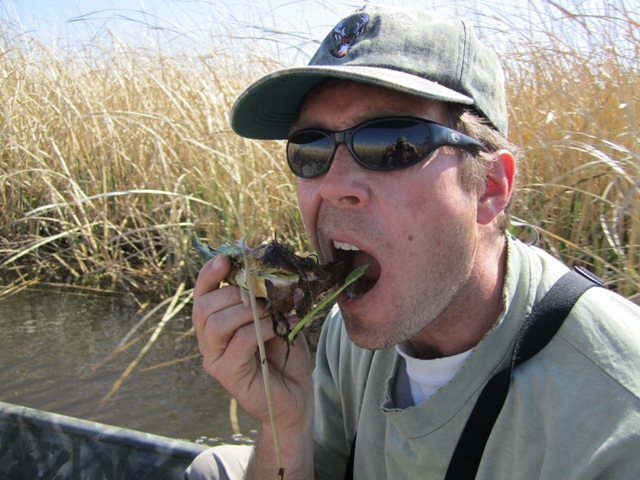
Pigs eat em. Why can't we?
As often happens in times like these, our group of hunters started to lose focus. I can only imagine David's ire as he watched the Brothers Degan and I slip into a period of frat boy buffoonery. Marsh roots were pulled for examination and tested for culinary qualities. A stick fight broke out in the bow of the boat and at some point, a fiddler crab was dropped down Brian's chest waders with satisfying results.

Things settled down a bit as we approached the next lookout post and a steady breeze across the marsh masked our clumsy hike to the base of the stand. David climbed the rungs to scan for hogs, but came back down after a few minutes with nothing to show for it. He insisted we were in a good spot, however, and recommended we post a lookout back up in the tree and sit tight until something showed itself. I elected myself for the job of hog spotter and climbed up to the top of the ladder. I had just settled in when a dark shape out in the marsh caught my attention. It was a decent-sized pig, 400 yards away. Before I could put my binoculars down, a second, smaller pig joined it and Brian's opportunity had finally appeared. While the rest of the guys prepared to head into the marsh, I stayed put to watch the pigs and direct the hunters' approach. The wind was perfect. The only things standing in the way of Brian's success were the poor eyesight of the wild pig and its compromised hearing ability thanks to the rustling sawgrass. Oh, and of course Death Options A and B; sink holes and man-eating alligators.
The stalk begins.
Slowly but surely, the trio made their way across the marsh to the two pigs, which continued to root around content and unaware. From its pig-level vantage, the party looked back to me a couple of times for redirection. After 20 minutes or so the culmination of their effort seemed imminent.

A tall field of sawgrass stood between Brian and David and the pigs as they made their final approach. From my perch nearly four football fields away, I could still see the smaller, reddish hog, but I'd lost sight of its larger companion. It seemed to me the boys were about to stumble right into the red pig and my mind was screaming a warning, "Look right! Look right! Oh for the love of God, look to your right!" But on they trudged and the pig kept feeding, unaware. Suddenly, I saw Brian draw his bowstring back to his cheek, but he wasn't aiming at the pig I could see. A flicker of motion signaled the release of the arrow and the bigger hog suddenly appeared in an opening to the left of Brian and Dave. I watched it stop, stand for a moment and stagger a bit before it trotted out of sight into heavy cover. As it disappeared into the grass, I could see the fletching of Brian's arrow sticking out of its flank. We had a hit.

The boys regrouped at the spot where Brian had shot his arrow and I thought I could see a fist-bump exchanged between the two brothers and a wide grin creeping across Brian's face. They waited a good 15 minutes and then started moving along the path the stricken hog had taken. I wanted to get down and join in the search, but I reasoned it would be better to stay put and provide bullet back-up if the pig reappeared. As the trackers entered the thick grass, I scanned the openings out ahead of them.

It wasn't long after that, I heard something heavy sloshing through the mud and heading in my direction. It came from the same general area from where I'd last seen Brain's pig and I shouldered my rifle and peered into the grass below. The back of a hog appeared, cruising in from my left. I clicked off the safety as the pig stopped in an opening some 20 yards from the base of my tree. This was not Brian's pig. This was something on a much grander scale. A giant silver and black spotted boar, weighing 200 pounds if he weighed an ounce, with alabaster tusks sticking way out past his gums, was standing broadside to me as he decided which way to go. This was no clean-up shot. This was a trophy boar of the finest class, in the prime of his life. But it was not my business to be shooting such a pig while the rest of the party blood-trailed another. Besides, I wasn't meant to be a shooter during this trip anyway. The boar moved slowly as it seemed to pick up our scent trail at the base of the tree and then he picked up his pace and disappeared into the endless sea of grass and the inner realm of my brain, where he will live for a very, very long time.

As I shook off the encounter, I noticed Mark waving me out of my perch to come join the rest of the gang out in the marsh. It took me a solid 10 minutes to reach them, where I found Brian, Mark and David standing over a very dead sow of 75 pounds. After years of trying, Brian had finally taken his first archery pig.
Great success!

Another long drag out of the marsh and we were headed back to Squirrel Creek Island, heavily laden with wild pork and stories to tell by the campfire for years to come. The tide was rising and the trip back was easy. Back at the cabin, Brian and Mark got to work breaking down the hog while David and I gathered up our gear and loaded the boat for the ride back to the ramp and civilization. Too soon, we were packing up the vehicles and saying our goodbyes. Mark and Brian had a bachelor weekend to attend down in Savannah and I had a long drive northwest to drop off the iced down pigs at Mark's place and then on to Black Mountain and home.

Home again - perhaps in body, but not in spirit, at least, not for awhile.

Editor's note: I have put up a video (thanks to Brian's editing) of our trip at The Bumbling Bushman Facebook page. Intrepid hunters with a sense of adventure are strongly encouraged to book a trip with David Thomas, who can be reached at 803-456-3387.

Tuesday, March 29, 2011

Hunting Marsh Hawgs (Part 1): The Place That Time Forgot

Mark at the (semi-) ready, searching for wild pigs.
There is a place, a vast and wild place, where you can experience the South Carolina Low Country in all of its beautiful, historic and natural glory. It was once a land of cypress swamps and brackish marshes, crisscrossed  by an ancient river, the Black, with all of its tidal creeks and narrow highlands of longleaf pine savannas. It is a place where ambitious white settlers grew rich on the backs of black slaves, who cleared the swamps (by hand), ditched the marshlands (by hand) and planted rice (by hand); Carolina Gold.

The rice fields are long gone, replaced through decades of neglect by sawgrass and of industry by impoundments, but the stately coastal plantations of antebellum remain as a reminder of days gone by, when this part of the South was a rich land of opportunity without peer.

That is not to say the marshlands between the Black River and the Intracoastal Waterway are now poor. In terms of wildlife, they are indeed bountiful. The place virtually bulges at the seams with life; alligators, turtles, catfish, gar, mullet, fiddler crabs, migrating waterfowl, herons, ospreys, bald eagles, anhingas, swallow-tailed kites and pigs, wild pigs, which is the reason I drove the 6-and-1/2 hours to get there last week.

It so happened the Brothers Degan needed a place to celebrate the start of Mark's bachelor weekend. Mark will soon be married and Brian wanted to take his little brother hog hunting before they met with a gang of ruffians in Savannah, Ga. to consummate the end of Mark's single life.

Our fearless guide, David Thomas.
It also so happened that I have friend with unique access and opportunity to offer would-be hog hunters in that particular part of the world. David Thomas is a native son of coastal South Carolina, a commercial fisherman, a bona fide redneck (in the very best sense) and an enthusiastic hunting guide with the seasonal rites to one of the planet's little slices of heaven - the Squirrel Creek Island Hunt Club.

I left Black Mountain at 3:30 a.m. to pick up Mark at his home outside Charlotte. From there, we drove toward the rising sun and the Samworth Wildlife Management Area boat ramp, to rendezvous with Brian and David. During our 20-minute boat ride to privately-owned Squirrel Creek Island and the 700-some acres of marshland it commands, David explained the variety of ways we could perish during our day-and-a-half adventure. We each had an option of A) death by sinkhole, B) death by man-eating alligator, C) death by disorientation and subsequent exposure or, most likely D) death by heart attack caused by shooting and dragging a massive wild boar across the middle of the marsh whilst trying to avoid options A through C. He promised, however, to do his best to keep us from such fates and we quickly pushed the dangers from our minds when he pulled the boat up to the landing at Squirrel Creek Island.
Squirrel Creek Island Hunt Club

The cabin (more like a lodge) is a testament to redneck ingenuity and hard work (in the very best sense). David was among the select few willing to take up the seemingly impossible task of ferrying building materials and construction of what, in my mind will always be the Taj Mahal of hunter-gatherer testosterone. It is a hunting lodge of unsurpassed maleness, with the all trappings and bric-a-brac of days afield gone by, a huge kitchen, eight beds, reliable plumbing, semi-reliable electricity, improbably reliable satellite TV and a porch perfectly situated to watch the always reliable sun setting over the marsh.

It was around noon as we quickly unloaded our gear and put David's plan into action. Brian and Mark took up their weapons (Mark with his scoped slug gun and Brian with his bow) and headed over to the end of the island where David has a tall two-seater ladder stand overlooking the marsh. In the meantime, the island's two corn feeders were filled up and David an I returned to the boat to go back and grab the rest of our stuff at the ramp. (I did tell you this was a 1-and-1/2 day hunt, right?)

Upon our return, some 90 minutes later, Mark and Brian reported they had seen nine wild pigs, all of them small, too small to bother with, but astonishing nonetheless considering the time of day and the minimal effort we'd put in so far. David considered leaving the Brothers Degan up there to wait out a bigger hog, but eventually chose to rally our party and take to the waterways in search of a spot-and-stalk opportunity.

As we putted through the ditches and levies that once served to access and maintain the now defunct rice fields, it was astonishing to think about the human labor that went into the transformation from swampland to agriculture in this endless tidewater.

David and his compatriots have continued in that spirit by turning the area into a hog hunter's dream. Throughout the marsh, they have erected ladder stands against tall, isolated cypress trees - the offspring of those mighty forests that once dominated - and created a means to locate and hunt the wild pigs that would otherwise be invisible as they forage in the sea of sawgrass and other marsh vegetation. On our way to one of these lookout posts, I spied a familiar shape swimming across the narrow canal in front of the boat. "Hog!" I announced excitedly in what was probably more than a stage whisper. I immediately received a stinging slap to the back of my head, but when I turned around to challenge the perpetrator, I dropped my ire amid the disapproving gaze of three sets of eyes. With the sizeable hog now alerted to our presence (don't ask me why they don't seem to be bothered by the sound of an outboard motor) we had no choice but to leave it alone and continue on in the hope of another chance.

We reached the stand, set against a lone, sentinel cypress in the middle of the marsh and David climbed up to glass the area. After a few minutes, he dismounted without any sightings to report, but he insisted it was a good spot and urged Mark to climb back up to stand watch with my rifle while the rest of us continued on to other lookouts.

We hadn't left Mark for more than 30 minutes when Brian's cell phone buzzed. It was Mark. "There are two pigs out in front of me - a red one and a marbled one. What do you want me to do?" "How far?" "75 yards." "How big?" "The marbled one looks pretty nice." "Then I want you to shoot that hog if you get a chance at it." "Will do captain."

David, Brian and I were almost to the base of another ladder stand so we kept on to it and climbed the rungs, all the while expecting to hear Mark's shot. From our vantage a quarter of a mile away, we could see Mark with the rifle shouldered, looking through the scope. We could also see four more hogs, about 400 yards out in front of us. KA-POOW. The pigs disappeared into the grass. The phone rang again. "Did you get him?" "Yep, he's down."

Mark directs the recovery of his hog.
Elated, we boarded the skiff and drove over to pick up Mark and his pig. His shot was perfect - a bullet between the ears at 75 yards and only a short distance to drag the 65-pound sow back to the canal where she could be loaded into the boat.

Despite the relatively short distance between the fallen hog and the boat, I finally understood David's earlier warning that nothing is easy out there in the marsh. As the two of us made our way to the pig, under the guidance of Mark, who remained in the stand, we took turns falling up to our crotches in the soft mud. Even as we crossed the areas of "solid" ground, the earth moved with every step. By the time we got the pig back to the boat, I was looking for an emergency asprin tablet and fearing I was about to succumb to Death Option D.

With a hog in the boat and everyone still alive, David suggested we head back to the island to get up into the stands overlooking the corn feeders, which were set to go off in a couple of hours.

Back on dry ground, the Brothers Degan headed off to one end of the island while I went to the stand they'd started out in at midday. The plan was to stay in radio contact and if I spotted a pig that looked like it could be stalked and the wind stayed right, I would call Brian over to give it a go with his archery tackle. After awhile, David came up and joined me on the watch. Minutes before the feeder was scheduled to go off, a healthy black sow with five shoats in tow crossed the marsh out in front of us. Their direction made it seem they would end up at Mark and Brian's location, so I called to alert them they were about to have company. Mark responded in a whisper. "We've already got five little ones feeding right in front of us."

At the news the Brothers Degan were covered up in hogs, David and I relaxed, sat back and watched the sun starting to set. Our careless conversation was interrupted only minutes later when the sow and her piglets decided to visit our side of the island instead. She came in on the high ground behind us and was about to tuck in to the freshly scattered corn when an errant breeze blew our scent over the set and she came up short. She was a nice one, 80 pounds maybe, and the shoats were pushing 20, but once she caught a whiff of human stink the jig was up and the gang disappeared back into the marsh.

Brian and Mark never saw a shooter pig as the dusk turned into darkness, but they had plenty of fun watching the group of little ones over the course of two hours, eating and tussling until it was too dark to see. We met back at the cabin for food and revelry which probably went on a little too far into the night, but what the hell - Mark had his hog, Duke was playing Arizona on the TV and the Squirrel Creek Island Hunt Club was rocking out in the middle of nowhere. Life was good and tomorrow was another day.

Come back soon for Hunting Marsh Hawgs: Day 2.
Hog fever!


Editor's note: Intrepid hunters looking for an adventure in the South Carolina Lowlands are strongly encouraged to give David Thomas a call and book a trip. He can be reached at 803-456-3387.

Tuesday, March 22, 2011

Season's Greetings (or) How To Kill A Turkey

Jason upon hearing the first gobble of the scouting season.


There are lots of ways to witness the coming of Spring. Some folks pick dandelion greens and toss them in salads. Others go birdwatching in search of neotropical migrants on their way back to the northern breeding grounds. Some struggle into neoprene waders and try to catch the first trout of the year. I go looking for wild turkeys.

With the North Carolina wild turkey opener just two and a half weeks away, it was high time I got into the woods to do some scouting. The real turkey hunters have been at it since February, but with an hour-long drive to my hunting spot, I waited until after the clocks moved ahead so I could wake up at a civilized hour and still be at my listening posts before dawn.

What am I doing there? I'm listening to the turkeys as they prepare to start their day and trying to pattern where they are and where they like to go during their morning rounds. Wild turkeys roost in trees at night to avoid predators. As morning approaches, the male turkeys often vocalize from their perches to rally the troops and let the hens know where they can find a boyfriend if they're in the mood. By listening to the toms gobble in the morning, a hunter can figure out where the birds are and how to be in position to intercept them once they fly down from the trees to start the day.

For the first scouting trip of the season, I invited my neighbor, Jason, who has expressed some interest in learning how to hunt. With hot coffee mugs in hand, we left Black Mountain at 5:30 a.m. and drove over the Eastern Continental Divide, then ESE, all the way to the northwest corner of Cleveland County. The pre-dawn air was mild and the moon was almost full and we drove most of the way with the windows down, talking about turkeys, strategy and why it is I love to hunt.

We parked the truck at the bottom of a ridge and hiked up past the spot where Sue and I will one day build our house. We reached the top with about 20 minutes to spare before dawn - a little tardy for my taste, but good enough for scouting. As we waited in the pale illumination, a rustling down the hill made me consider telling Jason about the valley's resident black bear. With time, the rustling drew close enough to discern individual footsteps and we stared wide-eyed into the heavy brush below us, trying to catch a glimpse of the mystery creature. Whether the deer finally saw us or caught a whiff of our scent, it panicked and took off up the valley, blowing while we chuckled with nervous relief.

A few minutes after that, the first songbirds started to call; a northern cardinal, then a towhee, then a crow and then, far up on the next ridge over, the crack and thunder we'd been listening for. The gobbler was a good ways off, certainly on the next property over and maybe beyond that, but his intermittent calls sparked responses from his rivals from up and down the valley.

We figured there were at least three, maybe four different toms gobbling on the ridge. If we had been hunting, I would have chosen to sit right where we were and try to call them down the hill to us. It was a good start, but none of the birds were as close as I would like them to have been, since we won't be able to chase any of them across the property line.

Then it happened; a gobble just down the slope to our right, so loud I practically jumped. There in the thick pine stand roosts the tom turkey I intend to kill on opening day. He only sounded off a couple of times before going silent. I figure he must have quit talking when he flew down, but I have a pretty good idea of which way he must have gone, since he didn't walk past Jason and I up on the hilltop. Setting up on this bird will be a challenge I think. The trail up the ridge passes near the edge of the pines and I don't want him to see me creeping by in the twilight as I try to set up above him. The best spot might just be the small area we cleared out during a work day on the property with a gang of friends a couple of years ago. We call it "Homesite A" because we thought for a long time that it would be where we'd build our home. At the moment, Homesite A has been bumped by Homesite B in terms of desirability for a dwelling, but it's close to the pine stand and might make a perfect spot to ambush the turkey of my desire.

As the sun finally peeked over the hills to the east, Jason and I listened on as the gobblers on the ridge above us continued to sound off. One bird seemed particularly enthusiastic and it wasn't long before we figured out he was heading down the hill in our general direction. I wanted to stay and find out where he was going, but then it became all too clear that this tom turkey was going to eventually end up in our laps if we didn't pick up and head down to the truck. We left just in time I think, as his thunderous gobble followed us down the hill until he finally stopped, I imagine right where we'd been standing with our hands in our pockets only minutes before.

The fact I now know where at least four - probably five - male turkeys like to hang out at night is no guarantee of success. Any bravado you may detect in my writing is merely that. I've been at this game long enough to realize the myriad things that can and probably will go wrong when I try to take down one of the wariest game animals on the continent. During the next two weeks, I'll be practicing with my calls and making a few more scouting trips to help tip the odds in my favor, but even so, this endeavor is a little like UNC Asheville taking on Pitt in the NCAA tournament - and I'm the Bulldogs.

To you non-turkey hunters, I both envy and pity you. I envy your civilized sleeping hours, your ambivalence toward mandatory tick checks, your blissful ignorance of the rage that comes with getting outsmarted by a bird with a brain the size of an acorn. I pity that you will  never know what it's like to see the leaves shake and hear the drumming of wingbone on breast just over your left shoulder as he struts in full fan and there's nothing you can do but wait and hope your heart doesn't explode.

Thursday, March 17, 2011

Making A Mess (Of Sausage Goodness)

Sausage on the hoof.
So, how exactly does one get from a large animal on the hoof to a freezer filled with a dizzying array of roasts, loins, rib racks, stocks, ground meat and sausage? The easy way is to field dress (remove the innards) your deer, elk, hog, antelope, etc. etc. and bring it to the local wild game processor. Once it's at the butcher's shop, your harvest will hang in a meat locker (typically frozen), dismembered into manageable cuts (often with a meat saw) and packaged and labeled for your home freezer (sometimes accurately, sometimes adequately).

Learning to butcher my own meat was part of my learning process as a hunter. My first hunting mentor, Dave, sometimes butchered his own and sometimes dropped it off with the processor, but he felt it was important enough for me to learn some rudimentary skills with my first deer kill. From him, I learned how to skin an animal, find and remove the tenderloins (arguably the most precious cut from any large mammal), neatly fillet out the backstraps (otherwise known as the loins), harvest the neck roast and break down the rest of the carcass into quarters (two hams and two shoulders). From there, I learned on my own how to separate and remove the various "roasts" from these large joints. Roasts are actually individual muscles that allow the intricate functions of motion.

After doing it myself a handful of times, I decided to take it easy when I lucked into a true trophy buck during a hunting trip in South Carolina. All I wanted to do with that deer was stare at its beautiful antlers (eventually on their way to the taxidermist). I really didn't feel like messing around with the butchering process. So I dropped the carcass off and picked it back up again a few days later. The packages of venison were neat and the ink stamps identifying each cut looked more professional than my magic marker labeling system, but the meat was... off. It became clear to me that in order to get the most from my deer, both yield and quality, I was going to have to do it myself from top to bottom. Since that realization, I've never looked back.

Now, before you think this post is going to continue down a boring path about sharp knives and blunt dissection, let me assuage your fear. No, dear readers, the only thing I want to write about today is making sausage. Sausage, sausage, glorious sausage. Apologies to Internet foodies who've seen sausage-making posts on just about every home cooking blog in existence, but I don't care. Making sausage is about the most fun a person can have in the kitchen.

For a primer on grinding "loose" sausage (sausage that is not cased), you could read an earlier post I did on making breakfast sausage. In fact, if you've never made sausage before, I highly recommend you start there (or any number of other food blogs, Hank Shaw's immediately comes to mind) to learn the basics. Today, however, I made sweet Italian link sausages out of a feral hog I shot down in Florida, back in January.

This is Sue's favorite homemade, fresh sausage recipe and it comes from the most-excellent book, "Charcuterie" by Michael Ruhlman and Brian Polcyn. I give you a list of ingredients and amounts, with the caveat that my version uses more domestic, farm raised pork fatback (almost 2 pounds instead of 1) because wild pork is leaner that the domestic pork the authors no doubt intend most people will have access to and I added more toasted fennel seeds to the spice mix because I like the hell out of them.

You will need...

4 pounds boneless pork shoulder (I used odds and ends from my hog), diced into 1-inch pieces
1 pound pork fatback, diced into 1-inch pieces
3 Tbsp kosher salt
Spice mix
2 Tbsp granulated sugar
2 tsp minced fresh garlic
2 Tbsp toasted fennel seeds
2 tsp coarsely ground black pepper
2 Tbsp sweet Spanish paprika
3/4 cup ice water
1/4 cup chilled red wine vinegar
and, 10 feet of natural hog casings (cleaned and soaked small intestines)

The quick (and hardly adequate) rundown is; you add the spice mixture to the diced meat and fat, allow it to sit for awhile to let the flavors penetrate (I left mine in the fridge overnight), run it through your meat grinder (what do you mean you don't have meat grinder?) work the water and vinegar in until the mixture is fully blended and sticky to the touch, pack the sausage filling into your sausage stuffer (what do you mean you don't have a sausage stuffer?) apply the hog casing over the nozzle (check out this cool product from The Sausage Maker; the pre-tubed, pre-washed natural casing) and crank out your totally awesome sweet Italian links.
Like so.

Trouble is, in addition to the very best, hands down, most flavorful, most satisfying, most gratifying sausage you'll ever eat, you're also left with a kitchen area that looks like someone has detonated a hand grenade.
Boom!  
I wish I could go on waxing poetically on forcing minced meat into pig guts, but Sue gets home from work in four hours and if I want to sleep in this house tonight, I have some clean up to do. Bon appetit!

Thursday, March 10, 2011

Spider Knows Peep Frogs

If it were up to me, we probably wouldn't volunteer for anything. Luckily, Sue feels a civic duty to sign us up for tree-hugger/citizen science things like the annual Breeding Bird Survey, the Christmas Bird Count and the North American Migration Count. That's all fine and dandy, I mean, who doesn't like counting stuff in the name of science and conservation? Well, this guy for one. Having the responsibility of collecting data that may or may not lead to the salvation of life on earth sounds great in theory, but more often than not, it comes with the price of missing an important football game on television or telling your buddies you can't go fishing.

Luckily, as I said, Sue has her priorities in better alignment than I do, so it was no surprise last week when she announced we were going to have to run our North Carolina Calling Amphibian Survey Program route soon or we'd miss the March 10 deadline for the first sampling window of 2011. That's right people; three times a year, you can give up your weeknight slate of cable programing to volunteer to count frogs in the middle of the night in strange and mysterious locales, in conjunction with the all-important North American Amphibian Monitoring Program.

Never heard of it? Can't fathom why counting frogs in their breeding sites is important work? The fact is, because of their fragility and susceptibility to minuscule changes in their habitat, amphibians make for perfect "canary in a coal mine" candidates when it comes to determining the overall health of the environment. Because frogs and toads use species-specific vocalizations to attract mates during the breeding season, they are especially useful as environmental bell-weathers. Anyone with half a mind to can learn to identify frogs and toads by their calls and thereby become officially qualified to count species and their relative abundance in an area (see the above link to NCCASP). In our frog surveying team of two, Sue is the primary frog counter and data collector while I head up the transportation and moral support aspects of the mission. In other words, just tell me where to stop the truck and listen to me whine while you stand out in the pitch blackness trying to do good for the world. (Sigh) life with the Bumbling Bushman is no picnic.

Tuesday was the night we ran our new survey route in the area of Old Fort, NC. Driving those seven miles from the house to the start of the route was our first challenge. Apparently, a couple of local boys decided to steal a pick-up truck and go for a joy ride on the back roads between Black Mountain and Ridgecrest.  Their trip ended abruptly when they crashed into a telephone pole and set power-lines down across NC 40. The ensuing traffic jam was epic as travelers were detoured off the main highway and through woefully inadequate Highway 70 for miles. (Read the short news bit here.) If not for a future forecast that resembled Armageddon (Wednesday) and a nighttime meeting tonight (Thursday) for Sue, we would have bagged it right then and there in the red glow of those ten thousand brake lights and gone home to watch "Glee."

Luckily, we were able to break free of the traffic just outside of town and breeze down the mountain while wondering in wide-eyed terror if the miles of stop-and-go heading in the other direction would be cleared up by the time we wanted to go back.

Our first census point was rather depressing. Three-inches of rain earlier in the week had the creeks and rivers running just under flood stage. No frog in its right mind was going to try to breed in the swift current. Any egg-laying would be for naught and besides, you couldn't even hear yourself think as the torrent of water tumbled downhill. I leaned against the hood of the truck in full-on "I told you this frog call survey thing was stupid" mode while Sue kept her back to me and counted exactly nothing for the required 5-minute census point. As I glanced at the stopwatch for the umpteenth time, I caught motion in the corner of my eye and re-focused on a small/medium mammal creeping up on us in the darkness. "Sue! Shine your light 10 feet in front of me," I panicked, with visions of rabid foxes and raccoons dancing in my head. Ready to stomp whatever menace appeared in the spotlight into oblivion, I breathed a sigh of relief when it turned out the nocturnal prowler was just a free-ranging tomcat, looking for a scratch behind the ears. When the frog-eating, songbird-mauling, small mammal-destroying SOB didn't get any love from either of us, the bastard decided to piss on my driver's side tire - twice. Awesome; and only nine more stops to go.

By stop No. 3, we still hadn't heard a frog and Sue was starting to lose some enthusiasm. "I'm cold."

By stop No. 4, we still hadn't heard a frog and Sue was getting bored. "I'm bored."

It's not looking good folks.
Stops 5-8 were more of the same; more lonely country roadsides, more pitch blackness, more rushing water, more frogless data points. In the world of science, no frogs is just as relevant as some frogs and even millions of frogs. In the world of reality, this was turning into a bust.

And then we came to stop No. 9 - unlike all the rest because it put us on the edge of a beaver swamp, not a creek or a river. The air was finally quiet, and there, off in the distance, a familiar chirp. "I hear peepers!" she exclaimed. There weren't many, maybe a half-dozen or so, but those little buggers -about the size of your thumbnail - made it all worthwhile. As we stood there listening, a truck pulled out from behind what we'd thought was an abandoned warehouse that we'd parked in front of. Instinctively, I told Sue to turn her headlamp off. No sense wearing a light between your eyes when faced with a potential itchy trigger finger. "Evenin'" I hailed as the truck pulled up beside us and the driver rolled down the window. "Just out here listenin' the the frogs." Which is exactly how I would have left things rather than going into details with an unknown entity with unknown motives. "Frogs?" he said. "What the hell are you doin' that for?" Like I said, generally I like to keep it simple in these cases. My response would have been something like, "Awww hell. We signed up for some cockamammy state-run program to count these damn frogs. And well, to tell you the truth, we're just shit house crazy." But Sue, bless her heart, takes these encounters as a chance to educate the public on topics of census protocol and wildlife conservation. "Actually, we're conducting a calling amphibian survey route. It's sponsored by the North Carolina Wildlife Resources Commission and the North American Amphibian Monitoring Program. We're doing 5-minute point counts along a set route and those spring peepers are the first frogs we've heard all night and..." "Peep frogs?" he said. "Your counting peep frogs? Who the hell pays you for that?"
Spring peeper, a.k.a. the "peep frog." (Photo by Phil Myers)
Turns out his name was Mike and his family owns much of the swamp and the land surrounding it. In an attempt to bridge the amphibious divide between us, Mike told us the damn peep frogs had been "hollerin' like hell" for the past few nights and the story of how he and his daughter would gig giant bullfrogs out of the swamp and eat their legs. "Ummm, wow. That sounds great Mike, we've got to keep on though. One more survey stop." (For the record, fresh bullfrog legs are one of the most delicious things to ever pass my lips.) Mike may have been drunk - he certainly smelled like beer - and once he got over his incredulity at our story, he couldn't have been nicer.

And then there was stop No. 10, where we didn't hear any frogs, but we met another local - Eddie, but you can call him Spider. Turns out, Spider and his wife owned some land on the other side of the swamp and we were more than welcome to go on down there any time and count whatever we liked. As a matter of fact, why didn't we follow him right now and he'd show us the trail through the woods that would take us to a dike that runs right through the middle of a beaver pond.

Sue looked at me with a raised eyebrow, but I figured, at 9 o'clock at night, on a back country road in the middle of Appalachia, and a little hike with a fella named Spider, what could possibly go wrong? Besides, I wanted to have a look in there and see if ol' Spider might be the sort to let a guy go and try to shoot some wood ducks or mallards when the season rolled around. Of course, Spider couldn't have been any nicer - nicer than Mike even - and we checked out the swamp (very nice in the dark) and left him with an open invitation to return and his cell number in case we'd be so kind as to let him know when we'd be back. 

The traffic going back up the mountain was clear by the time we passed through and I'm reminded that it doesn't take very much to turn a bad day into a good one - a couple of frogs and the kindness of strangers seems more than enough.